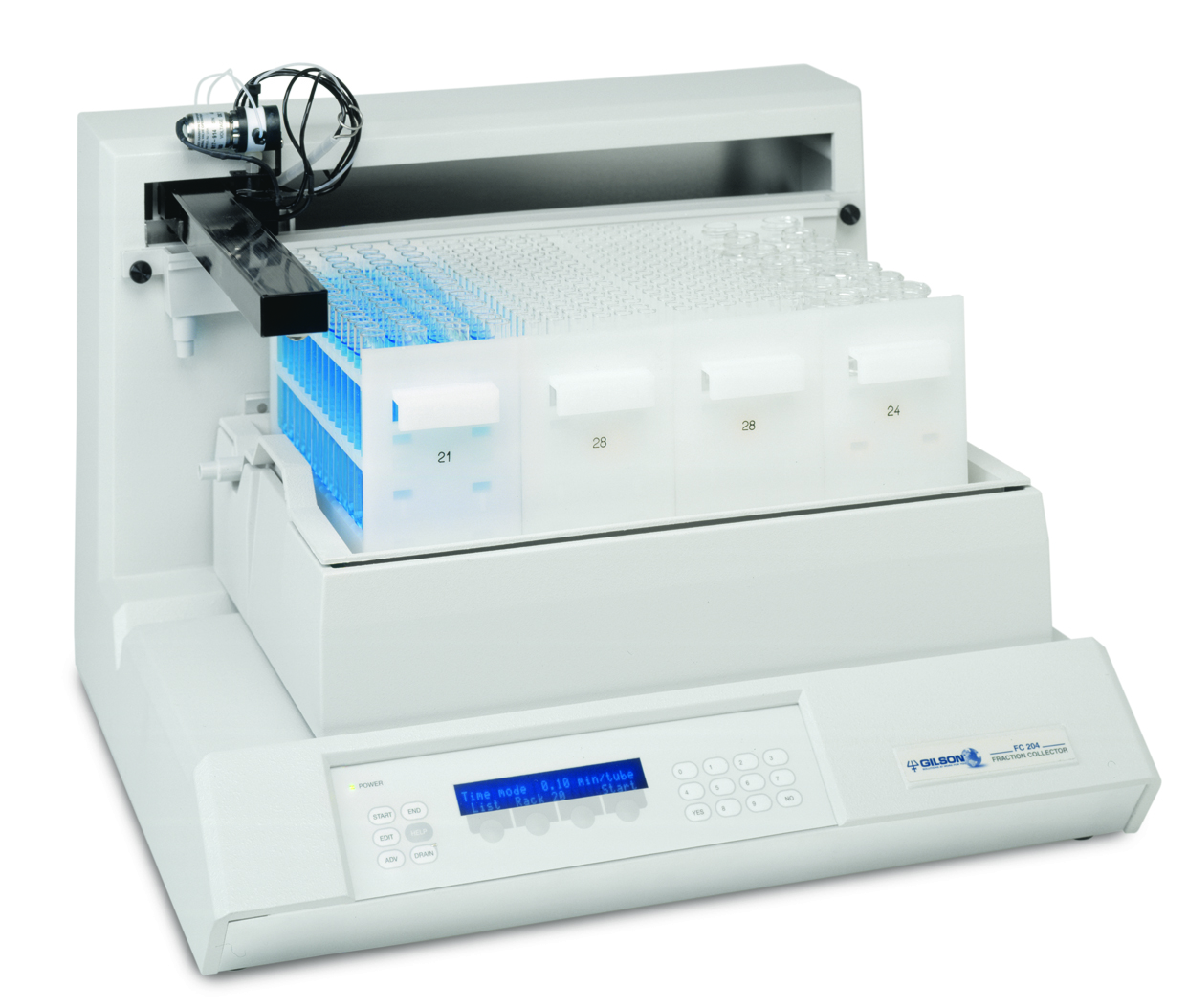
Peak-based fraction collection has the advantage that it’s based on real-time information. Your detector reveals a peak of interest, and the peak meets the criteria for collection. However, your molecules of interest are in the detector when you see the signal and they need to pass through more tubing and parts before it can be collected. So how do you know when it is best to collect your sample? By knowing the fraction delay time.
The fraction delay time is the time it takes a molecule to travel from the detector and out of the fraction collector. The delay time is based on several factors including the flow rate and the fraction delay volume. As the term suggests, the fraction delay volume is the tubing volume between the detector and the fraction collector.
Fraction delay volume and dley time are related as follows:
Delay time = delay volume / flow rate
Why Does Calculating an Accurate Fraction Delay Time Matter?
Knowing the fraction delay time is important because it informs when you would collect your molecules of interest. Having an accurate delay time means you will be collecting what you are seeing in the detector precisely and accurately.
Collecting too soon or too late can cause you to miss the peak entirely. Alternatively, you might not collect a portion of the peak, which reduces overall yield and dilutes your molecules of interest. Furthermore, an inaccurate delay time could also mean reducing the purity of your sample as you may collect nearby contaminating substances. If you are collecting material that is rare or costly, losing even a little bit of the material can add significant costs to your process.
What Contributes to Delay Time?
Several pieces of the chromatography system and fraction collector contribute to the delay time. This includes any space that the molecules must travel through including:
- Tubing connecting the detector’s outlet and the fraction collector’s inlet. Both the tubing’s internal diameter and length are important for calculating delay time.
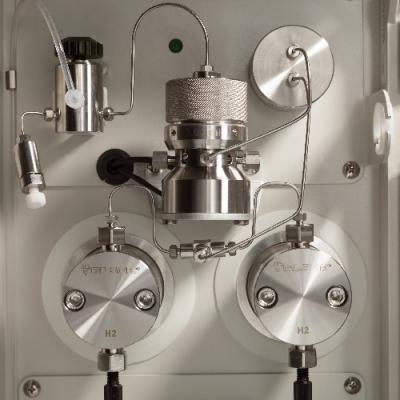
- Fraction collection valve, which directs flow either to waste or for collection.
How to Calibrate Fraction Delay Time
Calibrating the fraction delay time is a one-time process for your configuration and can be recalculated if you use a different flow rate. However, if you make changes to the flow path, recalibrating is more complex because you could potentially alter the volume between the detector and the fraction collector.
Manual methods for calibrating the fraction delay time involve injecting a dye into the system. In this process, the injected dye passes through the detector, giving a peak. You then watch for the dye to come out into the fraction collector. You would use the time it takes for the dye to exit as the fraction delay time.
Some software can also determine delay time automatically. Gilson’s Fraction Collection Delay Volume Calculator, allows you to input system configuration information, including tubing length, detector flow cell, and fraction collection valve, and provides the corresponding delay to input into the chromatography software. Contact our team of experts to learn more about this tool.
Tech Note: Optimized Fraction Collection for Prep HPLC
In this technical note, we highlight how our software and products help you add extra dimensions to your fraction collection possibilities allowing you to set conditions according to specific requirements for synthetic compound purification.
Read More
If your flow path includes a second detector, you’ll also need to determine the delay time between the detectors. For example, consider a flow path of a chromatography system where compounds travel through a UV/VIS detector to the fraction collector, with part of the flow diverted to a MS detector. Here, part of a peak identified by the UV detector will travel to the MS where you can confirm the compound of interest by mass. In this setup, you’d need to calculate the delay time between the UV and the MS detector to line up the peaks for the two detectors, as well as the fraction delay time between the UV detector and the fraction collector.
Incorporating Fraction Delay in TRILUTION® LC
Gilson’s TRILUTION® LC software, which controls HPLC and automated liquid handling systems, offers a user-friendly way to control fraction collection. Simply input the delay volume calculated by the Fraction Collection Delay Volume Calculator in the software configuration, and TRILUTION® LC will automatically convert delay volume to delay time based on the method flow rate, allowing the method flow rate to be variable.
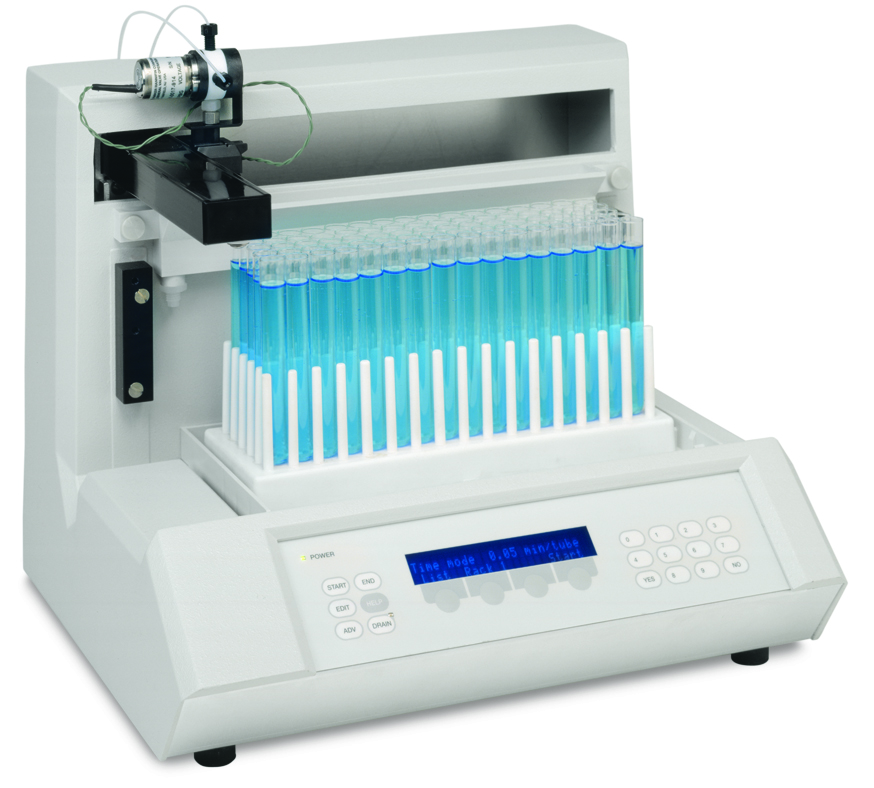
Our fraction collectors support various collection parameters including peak-based fraction collection using UV and MS detectors. Talk to an expert to learn more.